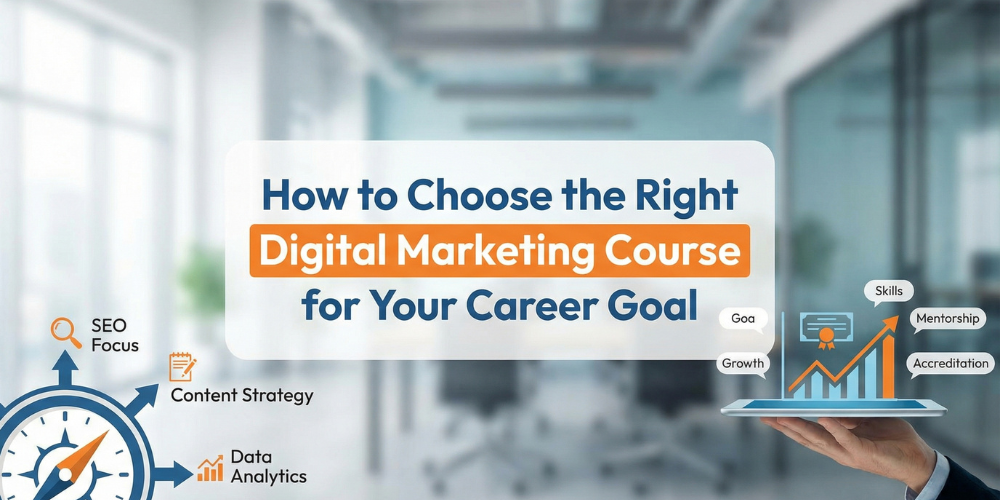
How to Choose the Right Digital Marketing Course for Your Career Goal
Embarking on your digital marketing journey is an exciting adventure! In a bustling city like Mumbai, your best course isn’t always the most famous; it’s the one that aligns with your career goals, builds practical skills, and truly prepares you for the real world.
Digital marketing is a broad field, so the right course for one person may not be right for another. A beginner seeking a first job, a student seeking a strong foundation, and a professional aiming for a higher role all need different kinds of learning. That is why your career goal should always come first.
Why your goal should guide your course choice
Before diving into course comparisons, take a moment to dream big—what do you hope to achieve? Are you aiming for your first digital marketing job, looking to pivot careers, planning to freelance, or eager to grow a business? Each aspiration deserves a tailored course!
Your goal decides the type of training you need. If you do not define that clearly, you may end up learning a little bit of everything without building the right depth. A course that aligns with your goal will save time, boost your confidence, and give your career direction.
Understand the main career paths.
Digital marketing has many specializations, each fitting different learners. If you prefer research and problem-solving, SEO may suit you. If you like numbers, campaigns, and measurable results, consider performance marketing and analytics.
If you are creative and enjoy storytelling, social media and content marketing could be the perfect match. If you want to work with websites, tools, and campaign execution, WordPress and technical marketing skills may help. When you understand where your interests lie, deciding on the course becomes much easier.
Look for practical training.
A good course shouldn’t be only theory. Digital marketing is hands-on, so practical training is essential. Work with real tools, analyze campaigns, create content, and see how platforms function.
The more hands-on practice you get, the stronger you’ll feel tackling interviews and real tasks. Employers are impressed by doers, not just memorization experts. Seek out courses where practice is at the heart of every lesson.
Make sure the syllabus is current.
The digital marketing industry changes quickly. A course that was useful a few years ago may no longer be sufficient today. Your training should cover the tools, strategies, and platforms that are relevant now.
A strong course should cover SEO, social media, performance marketing, content marketing, Google Analytics 4, WordPress, and AI-driven marketing. If the syllabus ignores industry needs, using the course for job growth will be harder.
Check whether the course matches your level.
Not every student starts equally. Some need basics. Others want advanced learning. Choose a course matching your level, not one that puts you at the wrong starting point.
This is where structured learning paths become useful. At institutes like Operating Media, learners can choose from options such as a Diploma in Digital Marketing, an Advanced Diploma in Digital Marketing, or the Master’s Program in Digital Strategy & AI-Driven Marketing. That kind of structure helps learners progress step by step, depending on their goals and experience.
Students wanting specific skills may choose certifications like SEO, PPC, Google Analytics (GA4), WordPress Development, and Social Media Optimization. This gives you flexibility while keeping learning practical and career-focused.
Choose a course that helps you build a portfolio.
A good digital marketing course helps you produce work to show. Employers want proof of practical ability. A portfolio with assignments, campaign examples, reports, and projects helps you stand out.
Courses offering live projects or structured tasks are strong choices. They show training is educational and career-focused. A portfolio is a powerful asset in interviews.
Consider the trainer’s experience.
The trainer matters. Industry experience helps trainers explain not just tools, but real business use. This makes learning relevant and useful.
Experienced trainers help you skip beginner mistakes. They know what employers expect and guide you toward key skills. This focuses and improves your learning.
Think about support after training.
A strong course continues after class ends. Also consider post-course help—resume support, interview prep, mentoring, and placement. These make a big difference.
This especially helps freshers and career switchers entering the field. The course should move you from training to opportunity. That transition is easier when the institute focuses on outcomes rather than just content.
How to compare institutes in Mumbai
Mumbai has many institutes, so compare carefully. Don’t choose by location, ads, or popularity. Compare structure, training style, practical exposure, and career support.
Ask these questions:
- Does the course align with my career goals?
- Will I get hands-on training?
- Is the syllabus updated?
- Can I build a portfolio?
- Are the trainers experienced?
- Does the institute offer different course levels?
- Is there support for interviews or jobs?
These questions help you judge if a course is truly useful for your future.
Final thoughts
The right digital marketing course aligns with your career goals and equips you with practical skills. It should build confidence, clarify the market, and demonstrate your abilities.
For those wanting a structured path, Operating Media offers practical learning with its Diploma, Advanced Diploma, and Master’s Program, plus specialized certifications to support diverse career goals. This flexibility makes it easier to choose a course that fits your needs.